All That Glitters Is Glass
A City College alum designs a stained glass collective with a unique approach
Story by Jesse David Long (jlong7@mail.ccsf.edu)
Photographs by Kyra Young
O
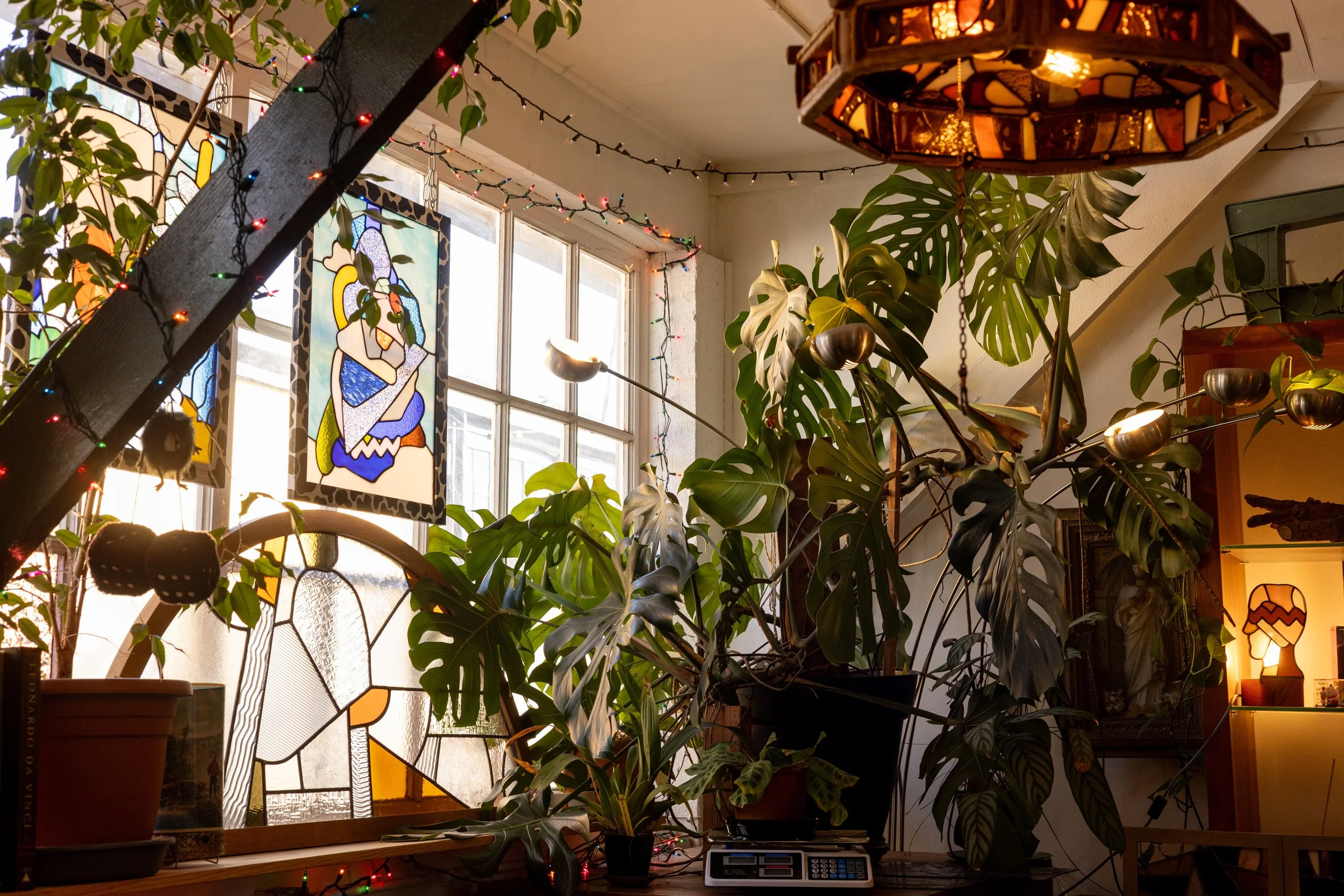
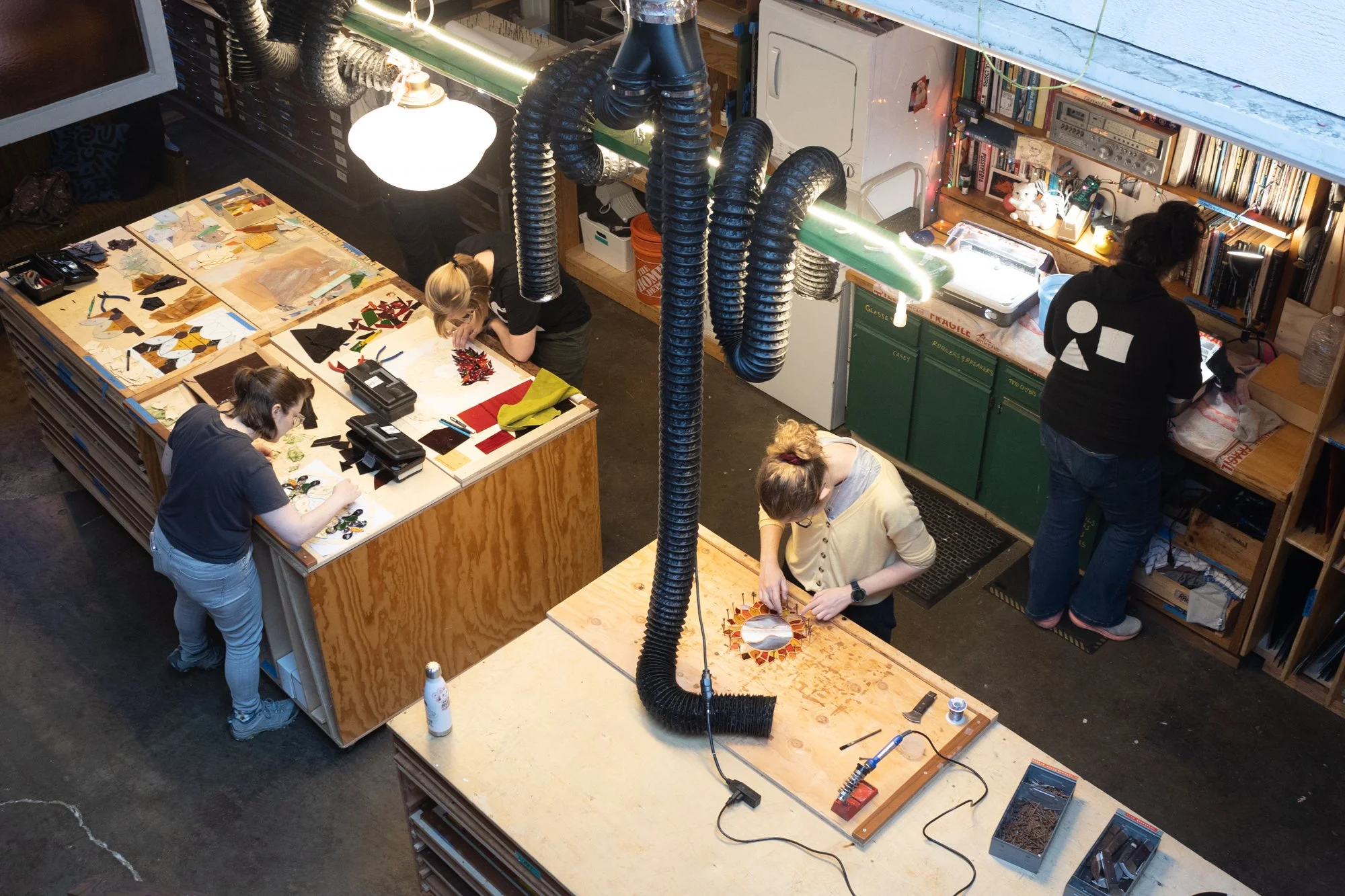
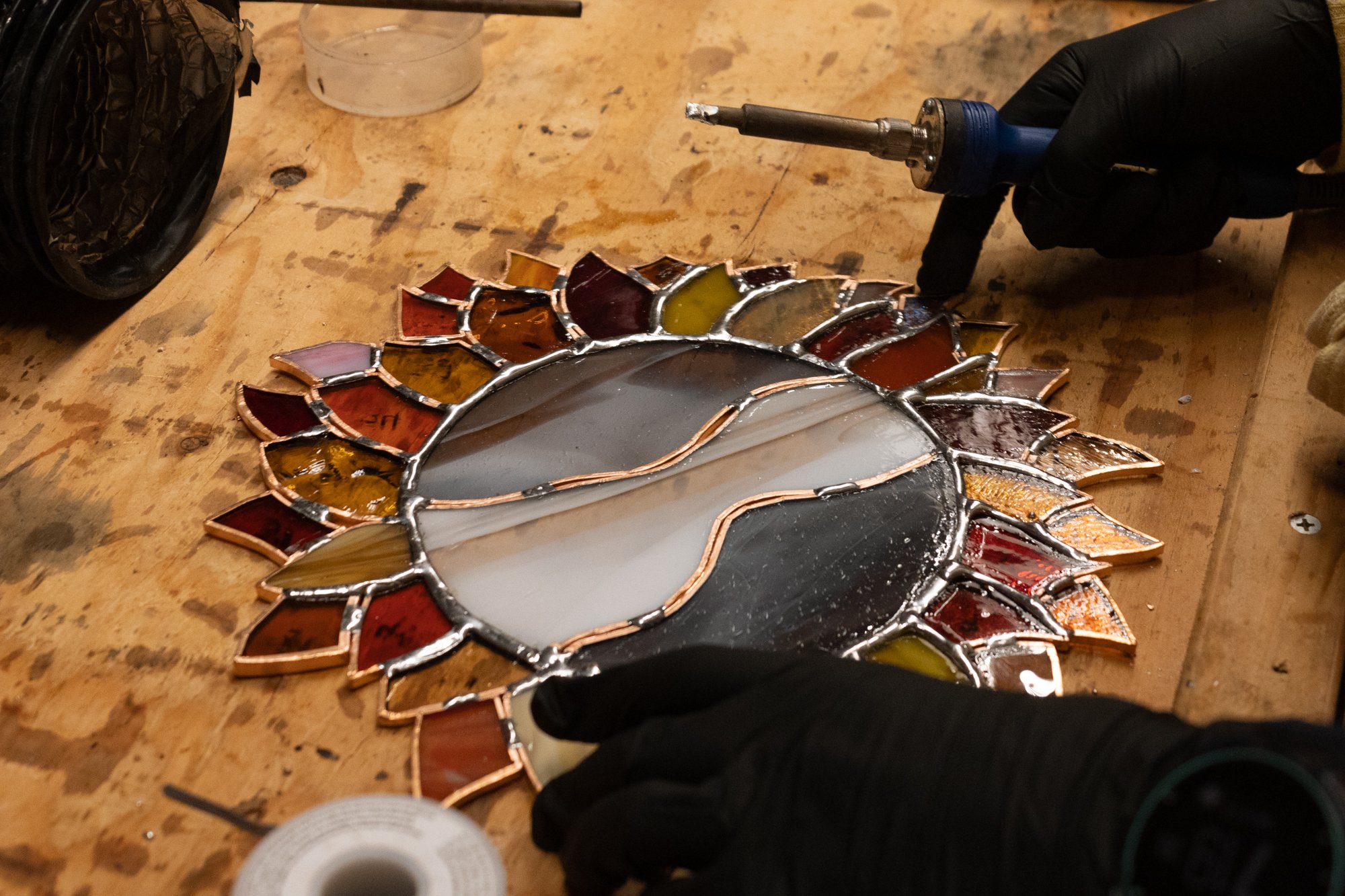
n a calm late summer evening, class at the East Bay Stained Glass collective begins its weekly ritual. Doo-wops and 1960s soul drifts lightly from a speaker as several students pull templates and panels from workbench compartments. Others collect channeled strips of zinc and lead from racks while their classmates connect soldering irons to power supplies, or arrange specialized tackle boxes that contain all the requisite tools for crafting a stained glass mosaic. Sheets of colored glass are stacked methodically along the studio's back wall.
The students maneuver around one another with a strange choreography as they assemble the different work stations. Although some projects are more developed than others, each artist follows the same process to prepare their piece for its next phase of construction. Students reposition exterior frames before organizing the numbered templates that will give structure to the patterns. Gradually, each artist's design takes shape, and cohesive geometrics become apparent.
One concentrically arranged panel bursts with a vibrant expression of deep oxblood red and volcanic orange flames, which envelope a neutral core. Bronze and amber conflations form a dazzling ring along its frame. Another panel suggests a subtle daybreak, highlighting subdued dawnlit peach and garden lavender petals along a verdant ellipse.
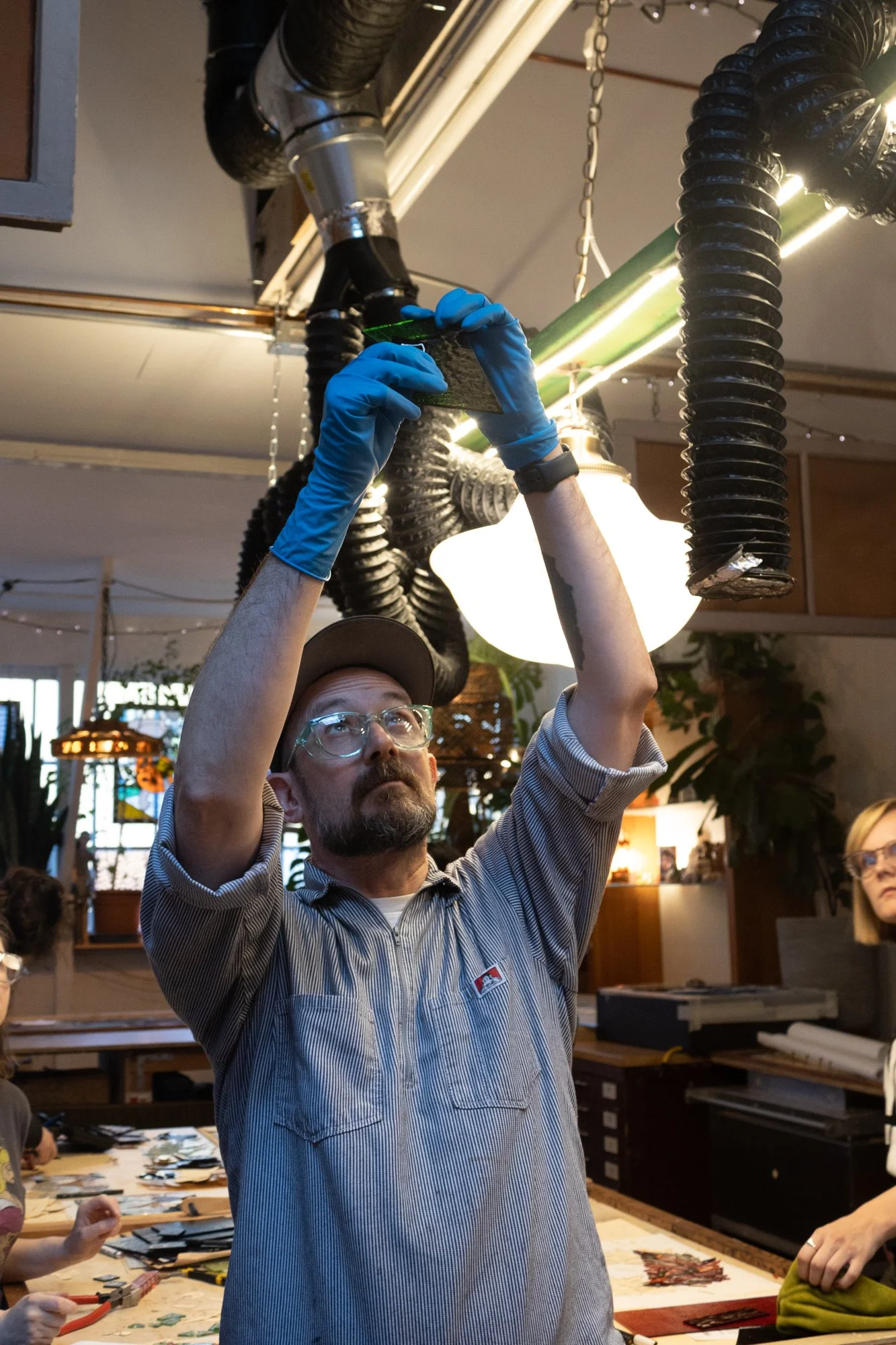
According to Casey Ress, instructor for the weekly classes and co-founder of the EBSGC, the unifying factor to each phrase of manufacturing is much simpler than appearances would suggest: "It's fun, all the individual components that go into this work, they're ultimately fun."
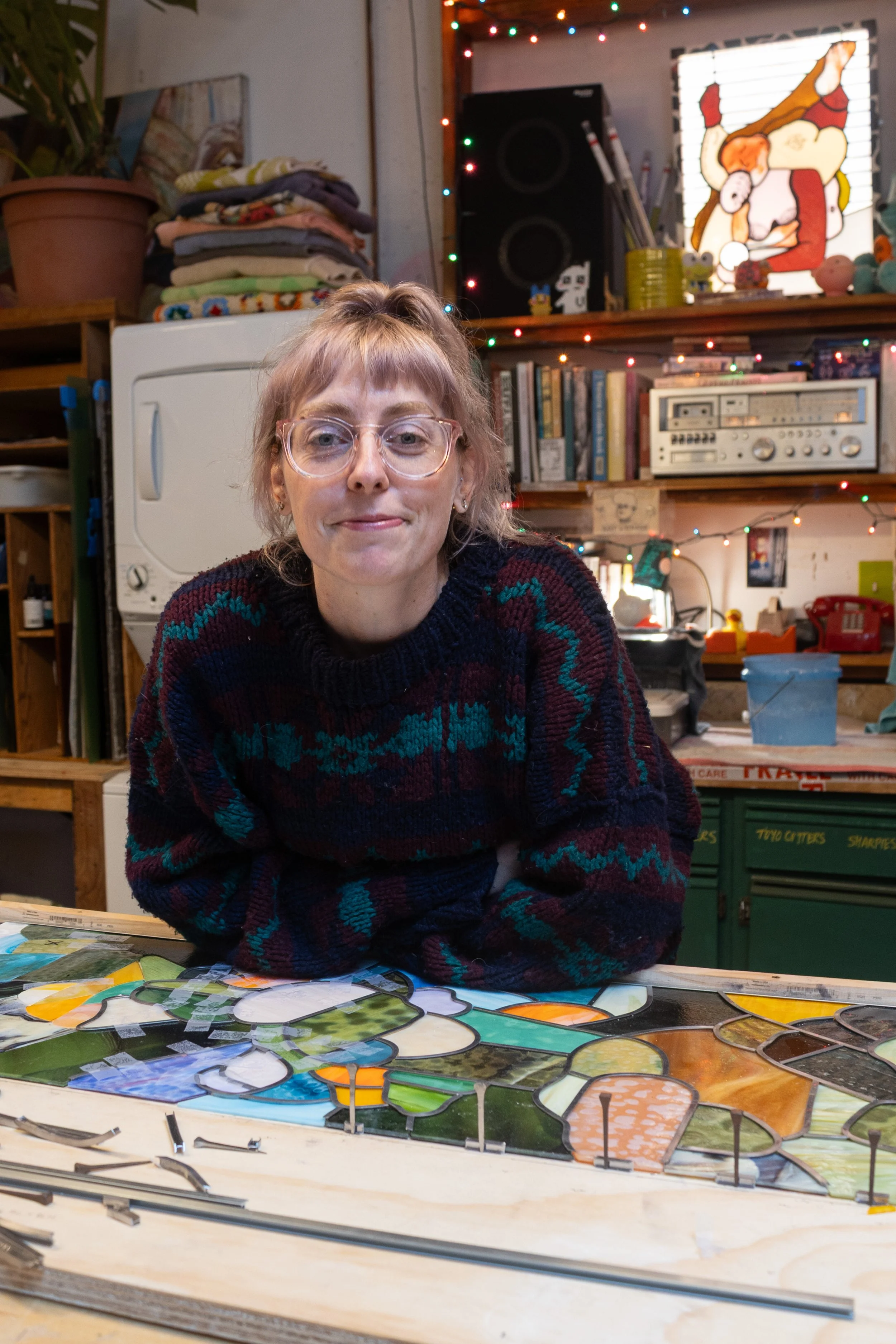
“As long as I can pay rent, feed my dog, have a little stability, I’ll be fine. I’m not looking for a second home, an expensive car,” Urbanowski says.
After adjusting to her new schedule, Urbanowski enrolled in classes at City College of San Francisco, focusing on children's book design and small business management. Eventually, curiosity steered her towards The Cradle of the Sun, a 48 year old stained glass studio managed by Dan Gamaldi. Gamaldi's instruction and encouragement motivated her to open her own art studio.
To refine her stained glass craft and open a studio, Urbanowski would need both her love for the creative process and a shrewd business acumen. She would also need a location for her workshop, seed money to launch the studio, and a continuous clientele to ensure a sustainable business model. Urbanowski started by focusing on the one variable she could control, funding, and pooled her resources by any means available.
"I would hustle my night lights," Urbanoski says, referring to one of her signature stained glass pieces she would sell during her late night bar shifts. "Clients would close out their tabs, I'd hand them their receipt and a night light and say, 'Here's the bill for your drinks, and you have to buy one of these from me, too.'"
This crowd sourcing might not have been the most scrupulous, or even entirely legal, but it forged the path for Urbanowski to secure her first stained glass studio, located in San Francisco's Dogpatch neighborhood.
After the initial opening, Urbanowski needed an extra pair of hands. "I was really broke, and I needed a lot of help. I didn't know what to do," she says. She was approached by friends who had learned of her predicament. "They told me, 'Hey, my 17 year-old niece is this funky, weird, artist kid who will work for free if you teach her,'" she says.
This is how Libby Regan began her internship, although Urbanowski downplays her role as a "teacher" with a more rational perspective. "Sometimes calling people 'students', it feels like, yuck," Urbanowski says. "All I can do is share all of the knowledge that I have, with the caveat that I also don't necessarily know what I'm talking about,” she says. "I'm only passing along the things that people have shared with me, things that have helped me. Do with that what you can."
Regan has her own take on Urbanowski's artistry. "The more I work with Kerbi, the more I'm like, 'Oh, my God, Kerbi's always right,'" Regan says. This appreciation stems from Urbanowski's tendency to stray from standard practices in her craft. "So much of traditional stained glass is using distinct templates," she explains, "But Kerbi's approach comes from the glass and the way that it's broken… she treats it like a collage."
Many of the materials in the studio are reclaimed and the artists often find themselves working with obscurely shaped pieces of glass with inconsistent lengths or erratic angles. "This is not necessarily an impediment," Regan says, “You see what kind of pieces you get, and try to find others that work well with it, then make them fit together smoothly."
Regan cut her teeth as a stained glass artist in her own right at Urbanowski's San Francisco location. "She just paid me by letting me use her Dogpatch Studio. I had an art show there and I sold all my art," Regan says of her time investment, "And she gave me a stained glass set up of my own."
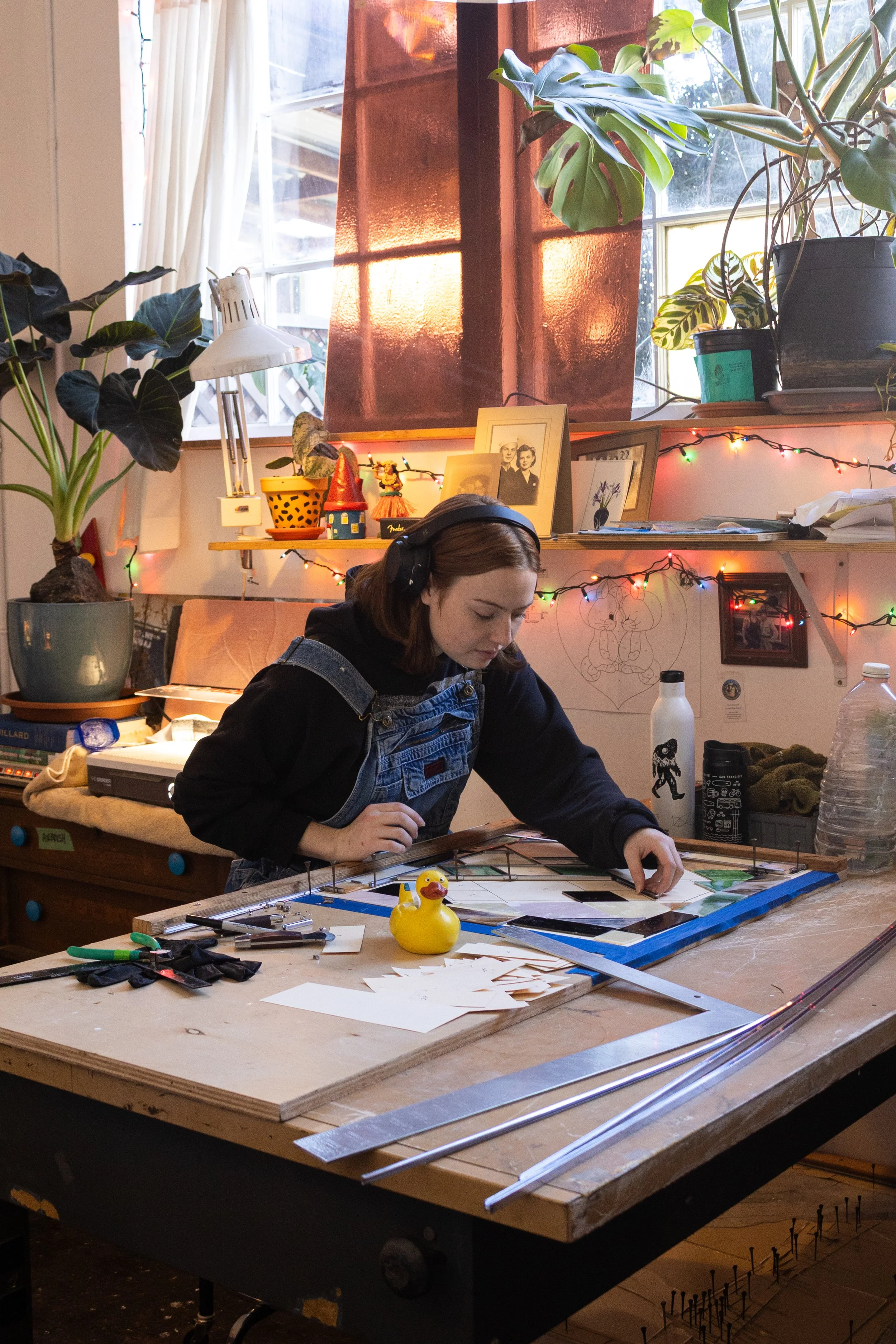
The introduction of such a remunerative account has impacted Urbanowski's growing enterprise substantially. Her first order of business after signing the contract was to offer full time employment to Regan, who had been working without direct compensation for nearly five years. Breaking this news to Regan and her family was emotional. "She started crying, her father was crying," Urbanowski says. "I was crying."
One of Urbanowski's personal treasures is a box of keepsakes she has labeled "The Sad Looking Ones," where discarded mementos of her failed attempts at creativity are laid to rest. She refuses to refer to these pieces of art as mistakes even though they range from the woefully misguided to the utterly grotesque. "When I look at these, I think, 'I was super into this when I was making it, so why is it the ugliest thing I have ever seen?' After all, they made it to the finish line, all the boxes were checked, so it makes me ask, 'what was I missing?'"
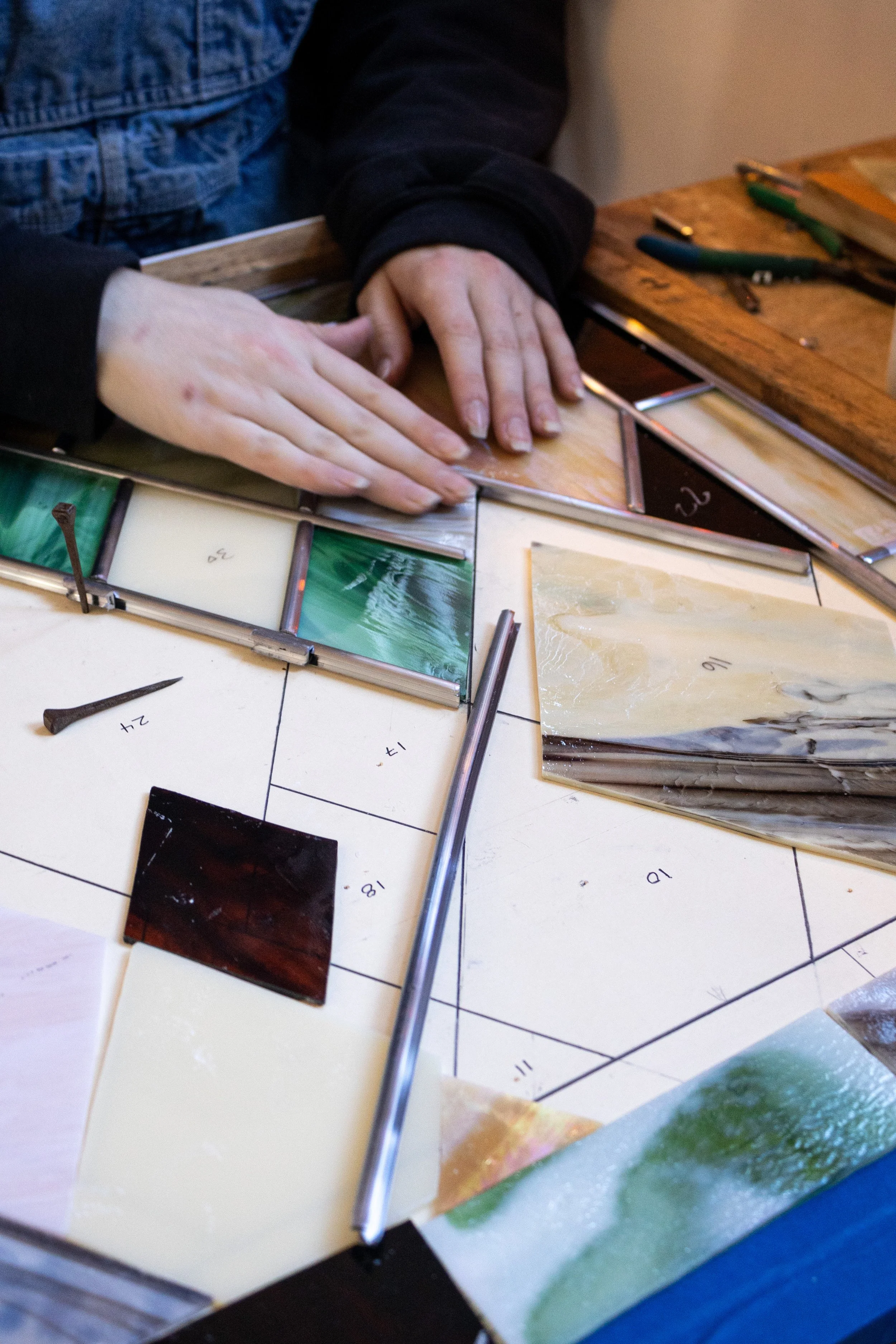
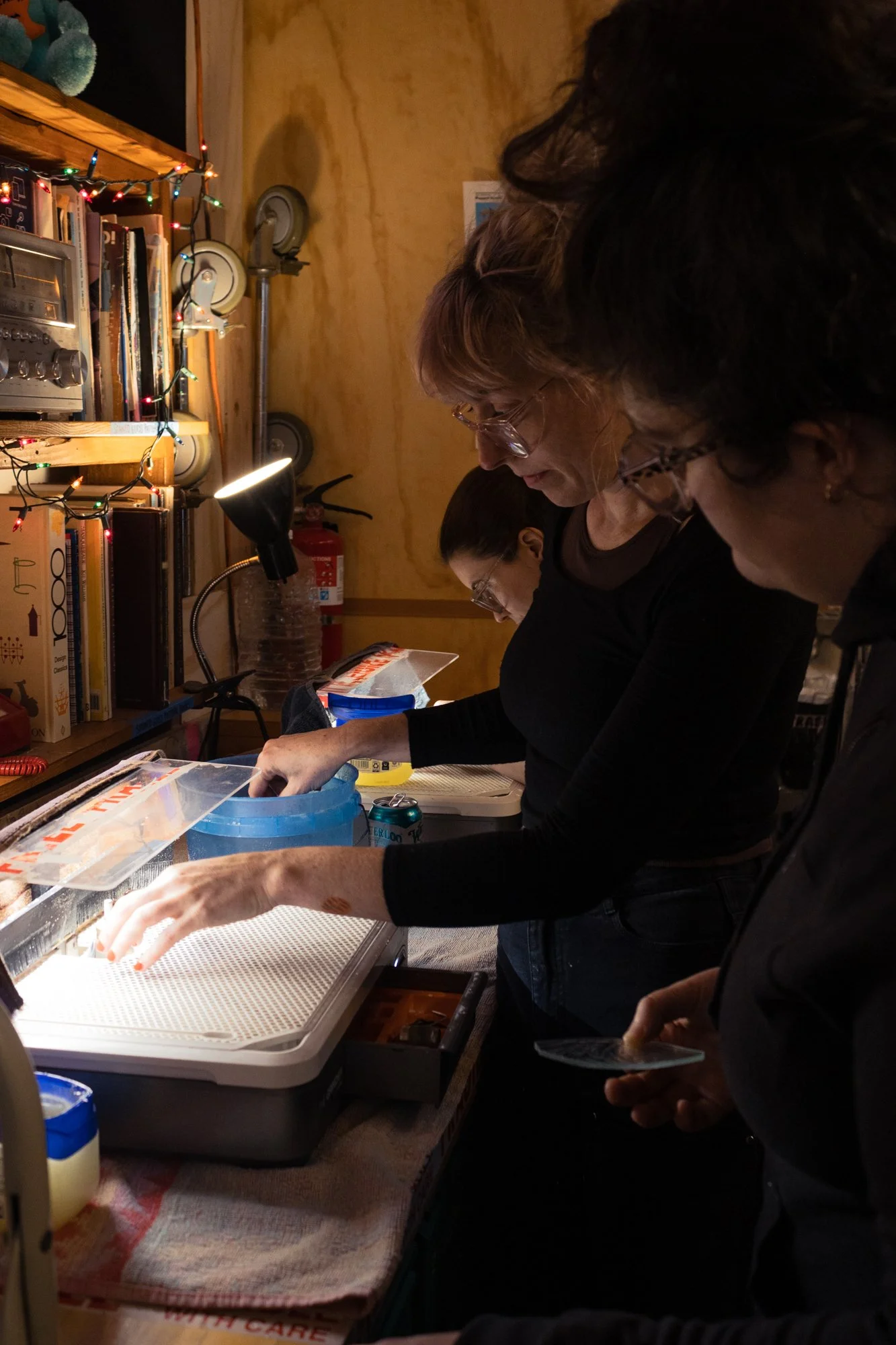
Libby Regan works on a commissioned stained glass window.
*Originally published in City College’s Etc Magazine. The pdf version of this article can be found here.
“ I would hustle my night lights. Clients would close out their tabs, I’d hand them their receipt and a night light and say, "‘Here’s the bill for your drinks, and you have to buy one of these from me, too.’”
— Kerbi Urbanowski
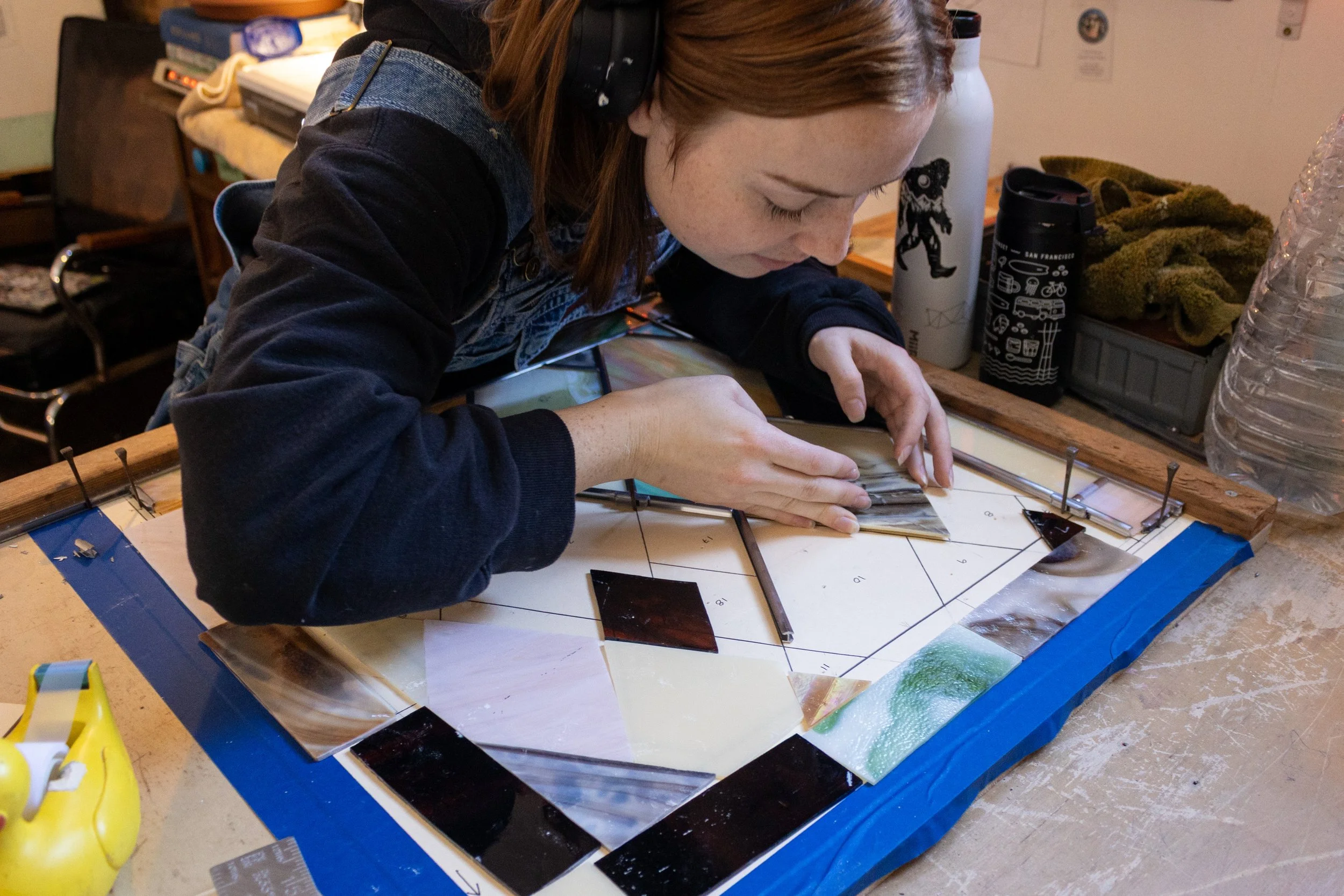
Libby Regan lays out pieces for one of four custom stained glass windows for a client.
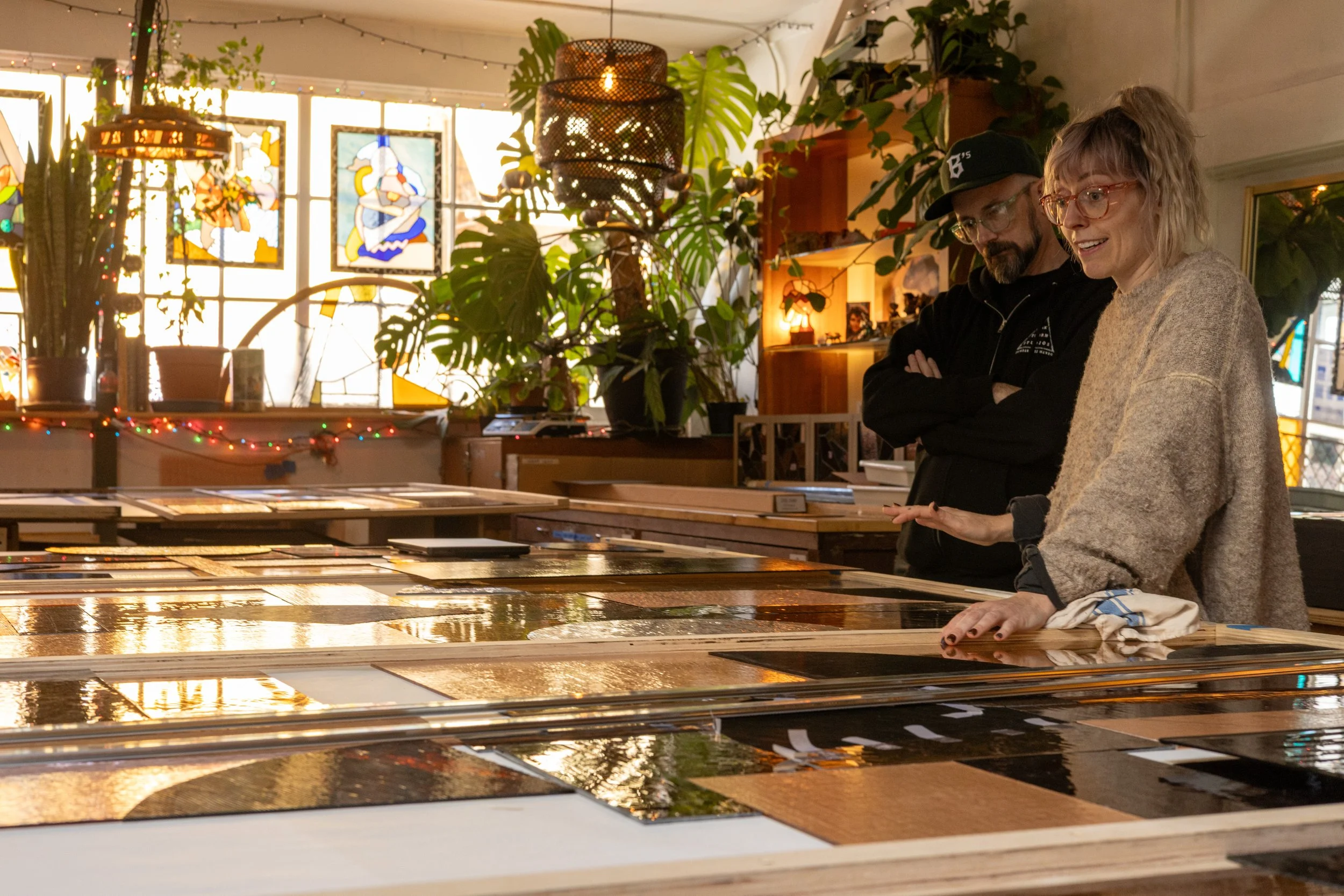
The decision to form the EBSGC started two years ago, when Ress reached out to Kerbi Urbanowski, owner of the workshop that houses the collective in Berkeley, California. Her business, Kerbi Urbanowski Stained Glass, specializes in customized commissions and renovations. After meeting Ress, Urbanowski saw the opportunity to share their time and experience with those who were interested in learning.
"He had been looking to teach classes in stained glass," Urbanowski says. Ress was looking for a simple rental arrangement. "He approached me and said, 'I'll bring the students, I'll teach the class, I just need to rent your studio space to work in.'"
Instead of limiting their approach to providing a basic introduction to the craft, the pair formed the collective with a more inclusive goal in mind. "Stained glass gets people in the door," Urbanowski says, "but I think some people just want to get out of the house and find an activity, or have a conversation with a new person, meet their community, meet their neighbors."
Instruction at the EBSGC combines elements of an art studio, classroom and community center. Ress teaches the classes, offered in four-week sessions each month. There are no requirements for membership in the collective, which provides daily access to the studio. The arrangement allows Urbanowski to work on her own art or projects she has been commissioned to construct, alongside members who hone their skills at a personalized pace.
The format of these weekly sessions has evolved in the 20 months since they began, moving towards more reasonable expectations. "We used to have it strictly be a four-week class," Ress notes, "and basically people had to rush the projects at the end and we found that wasn't a great system." Rather than forcing the process, the EBSGC encourages artists to continue their work in the next session of classes.
"One of the things I try to instill," Ress explains, "if you're here, and you feel like you're working, well, we're probably not doing it right. So the goal is to have a community, have a place where you can work on art."
Ress describes the stained glass process as straightforward, without surprises. "Someone will come in next week, fresh, and they'll see someone foiling, they'll see someone cutting, someone will be soldering. They'll see each step along the way." When asked if the procedure has ever been too overwhelming for a student, Ress replies, "Everyone finishes, it sometimes just takes a little longer." This could easily summarize Urbanowski's persistence as an artist.
After completing her degree in painting at the San Francisco Art Institute in 2012, Urbanowski met with a devastating injury, particularly for a visual artist — she completely lost vision in one eye. Corrective surgery repeatedly failed to restore her lost eyesight, and Urbanowski spent over a year learning to navigate life under compromised conditions. "I couldn't take care of myself," Urbanowski reveals, "I lost my job, I had no income, I had to give up my apartment. I had to leave, I had to go stay with my family."
While living with relatives in Illinois, Urbanowski's third surgery successfully stabilized her vision, and her rehabilitation was finally able to materialize. "When I healed up enough that I could be on my own, I moved back to San Francisco,” she says.
Urbanowski's San Francisco homecoming was met with an outpouring of support. "Everyone who heard what happened to me just came to my rescue," she says. She was offered bartending shifts at several local dive bars. "I got a job at The Rite Spot, 500 Club, Beauty Bar."
Together, the pair continued to build the Dogpatch stained glass studio until it outgrew its capacity. "She was working every day for free, just hustling," Urbanowski recalls, "Then when we moved here, she helped me move everything, helped paint, the whole process." The transition from San Francisco to the East Bay allowed Urbanowski to expand her scope and vision for her business and to reflect on personal priorities.
She concedes that her approach to finances is unconventional, a facet she attributes to her "angry anarchist brain," yet she is adamant about her principles. "Some parts of a business mindset don't have to be around making money," she says.
Urbanowski embraces her altruism, but admits that the realities of operating an artistic studio in the Bay Area are daunting. "There were a lot of long nights. A lot of tears," Urbanowski recalls. She is also willing to concede that her business strategy isn't the most profit-oriented. "Is it a bad business model? Sure. But if my idea of success is fostering relationships, trying to find joy, then it's working," she says.
Urbanowski attributes her professional progress to her ideals, but she tries to remain lighthearted. "Casey (Ress) would make fun of me," she muses. "He calls me allergic to making a living."
All teasing aside, it is Urbanowski's core beliefs which are the ultimate basis of her strategic planning. "Any time I start leading with fear, or the concern that I'm going to run out of money, or run out of material, or run out of time, I realize I actually need to evaluate what the problem is. And it's in those moments where I probably need to be more generous and give more," she says.
Urbanowski refuses to implement a monthly membership fee, which would guarantee the collective a consistent and defined revenue stream. Instead, she charges artists an hourly rate. "I work with people," she says, "if you don't have any money, you can still come," adding that she has extensive experience in creative bartering.
Urbanowski’s ability to follow her own artistic path speaks directly to her ability to create an environment where others are encouraged to forge their own. "I've been very stubborn about this," she insists, "To my detriment."
Her persistence eventually paid off. In January of 2025, Urbanowski was contracted to fabricate the stained glass furnishings which will be installed in Open AI's latest corporate office, located in San Francisco's Mission Bay. These include an ornate design inlaid in custom oak doors to the office of the Chief Executive Officer and a 6-foot high partition stretching over a 26-foot span in the main lobby. Additionally, a rounded awning comprised of more than four dozen stained glass panels will cover the interior of the company cafe. The contract, Urbanowski's largest to date, will be finished by the end of the year.
The willingness to ask these questions is central to Urbanowski's creative process. "It's worthy of understanding," she states simply, "It's just learning."
Once her OpenAI commission is complete, Urbanowski will take a well-deserved break from her workshop. "Casey will be running things," she says, referring to classes and operations for the EBSGC in early 2026. Regan will be there too. Once Urbanowski returns, she plans to continue developing the relationships she has made in her studio and the joy they provide. "It's not even about stained glass at this point," she says.